Showing posts with label Economy. Show all posts

Monday, April 1, 2013

"Effects of PH Investment Grade to Trickle Down to Poor"

IN THE NEWS from ABS-CBN News Channel


Perfect timing. The punchline is in the title.

You'll find a shorter version of the video here.

Thursday, March 28, 2013

Philippines Receives Investment Grade Credit Rating for the First Time Ever

IN THE NEWS

Yesterday, Fitch Ratings upgraded the credit rating of the Philippines to "investment grade," from "BB+" to "BBB-".

How did we react to the news? First, by giving each other virtual pats-on-the-backs and high fives.

Good job
Second, by buying stocks like crazy, leading to a 2.74% rise in the PSEi, ~5% price increases for "blue chip" stocks, and more than half of "top losers" being in the green.


But what does the credit rating upgrade really mean for the ordinary Filipino? The Rappler sums it up pretty nicely with this infographic.


One thing we have to watch out for is how fast banks and other financial institutions will adjust interest rates on consumer and household debt. If memory serves me right, they're too slow.

So yeah, the upgrade tells us that there are plenty of reasons to be excited and optimistic. We just have to try to be not too excited and optimistic.

Monday, March 18, 2013

Asian Stocks Drop the Most in Eight Months Amid Cyprus Bailout

IN THE NEWS from Bloomberg

From Bloomberg Businessweek
This may be big news for some, and not so big for others

The MSCI Asia Pacific Index dropped by 1.89% today, the most in eight months, just after the announcement of an EU bailout of the island-nation of Cyprus. The bailout was granted under the condition of a one-off tax on bank deposits: 6.75% for deposits of less than 100,000 euros and 9.9% for deposits of more than 100,000 euros.

The PSEi was down 1.78% for the day.

News of the bailout, perhaps not surprisingly, was met with outrage and some degree of panic among the Cypriot public. Numerous accounts of people queuing in front of ATMs to take their money out raise the possibility of a widespread bank run in the coming days.

Be sure to keep your eyes peeled for the latest news about the bailout and its effect on the global economy in the coming days.

Thursday, March 14, 2013

Reporting Income and Wealth Inequality: The Right Way or the Highway

I completely agree that income and wealth inequality are serious problems that need to be addressed, or at the very least, discussed. So I wholeheartedly support efforts to make the public more aware of the problem, such as this recent article by Interaksyon. What I don't like is using facts or statistics inappropriately to get one's point across or push a particular agenda.

Case in point.

The article refers to a presentation by former economic chief Cielito Habito which shows that:

In 2011 the 40 richest families on the Forbes wealth list accounted for 76 percent of the country's gross domestic product (GDP) growth. This was the highest in Asia, compared with Thailand where the top 40 accounted for 33.7 percent of wealth growth, 5.6 percent for Malaysia, and just 2.8 percent for Japan.

While I won't go so far as to say that Prof. Habito was wrong (I have the utmost respect for him), I do have questions, and maybe some reservations. How did he arrive at 76%? It is important to ask this question because the statement implies that the rest of the country--the 100 or so million minus the members of the Forbes' Top 40--"account for" 24% of the country's GDP growth.

Going by how the statement was worded, it seems that 76% comes from getting the total wealth of the 40 richest families in the Philippines (based on the 2011 Forbes list) and dividing the sum by the change in GDP in 2011, or some similar wealth-to-income comparison (you can try using the Forbes data and this chart from Google for a ballpark replication). If you think about this method for a moment, you'll realize that it's not appropriate because the total wealth of all people in the Philippines is not equal to the change in GDP, or even to the total GDP in one period. Wealth is not the same as income (one can interpret GDP as the income of a country in a particular period); income is what one earns every period and wealth is essentially accumulated income.

The article further compounds the issue by saying:

According to the Forbes 2012 annual rich list, the two wealthiest people in the Philippines, ethnic Chinese magnates Henry Sy and Lucio Tan, were worth a combined $13.6 billion. This equated to six percent of the entire Philippine economy.

I take it by "Philippine economy," the author meant "GDP." Here, the wealth-to-income comparison--and thus the misuse of data--is clearer. Google quotes the Philippines' GDP in 2011 to be $ 224.75 billion, so 13.6/224.75 = 6%, which is exactly what the author cites as proof for her thesis. But again, the comparison does not make sense! It does not mean that the wealth of the rest of the Philippine population sans Henry Sy and Lucio Tan is 94%!

My point is that if you want to highlight wealth inequality, then do it correctly: compare the wealth of individuals or a group of individuals to the total wealth in the country. You want to discuss income inequality, then compare income to income.

Income and wealth inequality are real problems not just in the Philippines, but in many parts of the world as well. If you want to use statistics to raise awareness about the issues, you owe it to your readers to do it the right way.

Here's one way of doing it.


Or using data from all around the Internet:

Total wealth in the world: $ 200 trillion
The Philippines' share of world wealth: 0.67%
Implied total wealth of the Philippines: $ 1,340 billion
Net worth of Philippines' Forbes' 40 richest: $ 47.43 billion
Percentage of Philippine wealth owned by Forbes' 40 richest: 3.5%

Not as exaggerated as the numbers used in the article, but still fully supports the case for wealth inequality. And this time, 3.5% means something.

Monday, February 11, 2013

Feeding the Frenzy: HSBC Analyst Talks about the Philippine Economy in 2013

IN THE NEWS

In this video from Bloomberg, Rishaad Salamat and HSBC's Trinh Nguyen discuss the outlook for economic growth in the Philippines for 2013.


Some highlights:
  • Indonesia is already investment grade and the Philippines is only expected to achieve investment grade at the second half of the year. Despite this, right now bond yields in Indonesia are higher than in the Philippines, implying that the credit rating upgrade is already "priced in" Philippine bonds and bond yields and prices won't be affected any further ("upgrade doesn't matter anymore"). The analyst, however, offers that the impending credit rating upgrade will affect the Philippine economy positively in other ways (e.g., lower borrowing costs for the Philippine government).
  • The Philippines' Consumption-driven economy and booming demographics will allow it to have another strong year. Remittances at 20 billion USD will continue to drive local consumption. Other important sectors such as the BPO sector will continue to support the economy.
  • HSBC predicts a 5% GDP growth in 2013. They also expect the Philippine peso to appreciate to 39.5 (to 1 USD) by the end of 2013.
Many of the factors that lead to the growth of the economy in the past year or so will continue to hold. So can the Philippines sustain growth in 2013? According to HSBC, YES.

Thursday, September 6, 2012

A Tale of Two Markets

IN THE NEWS

I arrived in Hong Kong exactly two years and one week ago. I decided then to take most of my capital with me and invest it and all future earnings in Hong Kong. Let's see how that decision turned out after two years...

Hong Kong Recession Risk May Increase On Exports, Tsang Says (Sep 3, 2012)

Hong Kong’s risk of a “technical recession” may increase after declines in exports and a slowdown in retail sales, Financial Secretary John Tsang said.

Hong Kong’s economy shrank 0.1 percent in the second quarter from the previous three months as the sovereign debt crisis in Europe capped export demand. China’s slowdown is dragging on trade, weighing on confidence and encouraging the million of mainlanders who visit each month to spend less on luxury goods.

The benchmark Hang Seng Index (HSI), down about 10 percent from this year’s high in February, was little changed as of 10:19 a.m. local time. Hong Kong’s retail sales grew in July at the slowest pace since the global financial crisis. The city’s exports fell 3.5 percent from a year earlier.

Performance of the Hang Seng Index in the past two years: -6.90%


Philippine Bourse Stock Sales Poised To Pick Up (Sep 3, 2012)

Philippine Stock Exchange Inc. (PSE) Chief Executive Officer Hans Sicat said share sales are poised to surpass the bourse’s full-year target as transactions accelerate toward the end of 2012.

Sicat sees three more initial public offerings being completed this year, he said in an interview last week, declining to name the companies. That would take the annual total to six, compared with five listings in 2011. There are enough funds in the stock market to absorb new IPOs or share sales by listed companies, he said.

Overseas investors have bought a net $2.15 billion of Philippine equities this year to Aug. 30, compared with $1.33 billion of purchases for all of 2011, amid optimism about the nation’s economic growth prospects. Philippine stock trading has averaged 6 billion pesos a day this year, compared with the 2011 average of 4.82 billion pesos, data compiled by Bloomberg show.

The Bangko Sentral ng Pilipinas cut its benchmark interest rate to a record-low 3.75 percent this year to spur spending and counter faltering global demand. The $225 billion economy grew 5.9 percent in the second quarter, faster than the 5.5 percent median prediction in a Bloomberg economist survey. Standard & Poor’s raised the Philippines’ debt rating in July to BB+, one step below investment grade and the highest level since 2003.

Performance of the PSEi in the past two years: +44.48%


It was not as bad as it seems, though. In the past two years, I bought in and out of the Hong Kong stock market a couple of times and was able to break even in that period. It's a bit disheartening to miss the incredible performance of the Philippine stock market in the past two years, but I'm definitely happy for those of you have benefited from the run. I don't regret my decision, not one bit; after all (and I'm sure someone already said this somewhere sometime), regret is for the weak.

Friday, August 3, 2012

More Reasons to be Optimistic about the Philippine Economy (?)

IN THE NEWS from PhilStar Online


It's not often that one comes across this much good news about the Philippines in one day. Just posting these excerpts in case you missed them.

Stock market rises to unprecedented heights

The Philippine stock market is making its mark as one of the hottest emerging markets in the world, having outperformed many of its regional rivals this year on the back of rosier macroeconomic fundamentals, a resilient corporate sector as well as government’s resolve in stamping out corruption. An improved fiscal situation, a growing middle class, stabilizing political situation and vast natural resources have likewise brought the Philippines back on the radar of foreign investors.

In the first half of the year, the Philippine Stock Exchange index (PSEi) vaulted to new all-time highs 19 times, rising 20 percent to close at 5,246.41 by the end of June. Last July 5, the PSEi shot to a new record high of 5,369.98. The PSEi has gained around 25 percent this year, making it the top performing market in Asia, outpacing bourses in Singapore, Indonesia, Malaysia, Thailand, Vietnam, Hong Kong, India and China, among others. After a sharp rally, local stocks have gotten costly compared to other Asian stocks, making some investors reluctant to stick around. The PSEi, trading at nearly 16 times projected annual earnings or nearly double South Korea’s 8.3 times, is now showing signs of topping out. It is now down by more than four percent from a record reached earlier this month as the euro zone’s debt crisis has worsened. (Emphasis is mine - IJ)

Phl on its way to achieving investment grade rating

The Philippines is on its way to achieving an investment grade rating from international rating agencies amid the reforms undertaken by the administration of President Aquino who is in the first half of his six-year term. Bangko Sentral ng Pilipinas Governor Amando Tetangco Jr. said rating agencies led by Standard and Poor’s (S&P), Moody’s Investor Service, and Fitch Ratings have recognized the efforts undertaken by the Philippines. This came after S&P upgraded the country’s credit rating to one notch below investment grade on a stable outlook, putting the agency’s assessment on the country at par with that of Fitch that also rates the Philippines a notch below investment grade. Moody’s, on the other hand, rates the country’s sovereign debt at two notches below investment grade but recently upgraded the country’s outlook to positive from stable, paving the way for a favorable action within the next 12 months to 18 months. If the Philippines is granted investment status, this would translate to lower borrowing costs and further attract more investments into the country.

The Philippines has obtained eight positive credit rating actions from S&P, Moody’s, and Fitch since President Aquino assumed office in June 2010. This enabled the Philippines to attain its highest credit rating in 13 years at one notch below investment grade.

Investor confidence in Phl rises: P-Noy's good governance pays off

The Philippines has seen renewed investor confidence over the past few months largely due to the Aquino administration’s good governance thrust. While greater investor confidence in the country is a reason to celebrate, this also means the government must continue to work hard to implement reforms to sustain the momentum.

Thursday, May 17, 2012

Putting the Philippines' Recent Economic Gains Into Perspective

IN THE NEWS

Bloomberg released a very interesting graphic today: how does the Philippines stack up against its ASEAN neighbors in terms of poverty alleviation, especially given the significant economic gains that the country and region has recently been experiencing? The answer, it seems, is "not to well"?


The above graph shows the GDP growth and poverty reduction rates of three ASEAN nations--the Philippines, Malaysia, and Thailand--since 1988. We see that while the Philippines has been able to keep up with the general pace of economic growth in the region, it has been a consistent laggard when it comes to poverty reduction (where lower or more negative means less poverty, so is better). 

On the surface, these statistics make us think: if the country as a whole is getting richer and the poor remain poor, where is the money going to? What the graphic makes clear is that the income inequality issue does not only apply to the US or China, where discussions have been most lively and publicized, but also to emerging markets like the Philippines. The problem is that a lot of us, Filipinos--or at least those who have Internet access--seem to have been deluded into complacency by the outperforming stock market and recent pats-on-the-back from ratings agencies and investment analysts. Income inequality in the Philippines has been a persistent problem--perhaps now more than ever--that we need to continue (or start?) talking about to at least have a chance to solve. Unfortunately, we are all too pleased with how well we've been doing to even care.

By the way, Bloomberg, if you're reading this--what's up with that x-axis?

Tuesday, January 31, 2012

18 Nobel-Worthy Insights from My Conversation with Dr. Joseph Stiglitz: Asian Financial Forum 2012, Part 3

ASIAN FINANCIAL FORUM 2012 SPECIAL

Dr. Stiglitz and veteran news personality Lorraine Hahn. Photo taken with my crappy cellphone camera which doesn't give Ms. Hahn's extraordinary beauty justice
A quick run through for insights 1 to 9:

1. Everyone's spooked because China's growth in 2011 was just 8% to 9%.
2. All eyes on Asia.
3. What a 0% savings rate really means.
4. What is saved in Asia should stay in Asia.
5. What "savings glut"?
6. Breaking something that ain't broke.
7. A case of diversification making things worse.
8. The problem with too-big-to-fail banks is that they are too big to fail, and everyone knows it.
9. The reason why we still haven't achieved transparency for complex financial products like credit default swaps and other financial derivatives is that that is how these people make money from these things.

And now for the much awaited continuation of this special series...

10. Restoring confidence in the US economy is a matter of green shoots turning brown. Economic recovery cannot be achieved with just a speech--especially if the facts disagree with what you're saying. For example, one oft-cited statistic is how unemployment has gone down from 9-point-something to 8-point-something percent the last time someone counted. Experts have interpreted this "dent in unemployment" as a sure sign of US economic recovery. But if you take a closer look at the numbers, the main reason for the decrease in the metric is that some people gave up looking for a job, so technically they don't count as unemployed anymore. The sad reality is that one out of every six Americans who want a job cannot find one...

11. One way to bring about economic recovery in the US is to restructure the economy and focus on increasing real productivity. That is to use less resources for the same output, particularly in agriculture and manufacturing.

12. Debt should be the least of the US's worries, if only because interest on US debt is very low at almost zero for short term debt and 3% for long term debt.

13. Austerity is to the economy as "blood letting" is to a sick person in the middle ages (or in Westeros, just ask the Boltons - IJ); as blood is drawn from the sick person, he or she gets worse, and medieval doctors respond with, wait for it--more blood letting! In other words, "austerity" or slashing spending will only make things worse for the American economy. At least until the poor soul finally dies. What the US should do instead is take advantage of low interest rates and invest in more value-creating projects, which are often just right under everyone's noses. Also, raising taxes and increasing spending actually increases GDP more than any austerity plan--if only it weren't for some genius politicians...

14. The end of the euro? Maybe we should not be so surprised. When the Eurozone was formed, economists were skeptical of whether or not it will prosper. Why? There's actually some sort of checklist for when it's appropriate for a group of countries to adopt a single currency. Guess what? These Eurozone countries did not satisfy these criteria.

15. Ratings agencies only contribute to the woes of Europe and the rest of the world. It is their moral responsibility to ensure that complex financial products are as transparent as possible. Unfortunately for all of us, in this case the "less moral" has outbid the "more moral", as is almost always the case.

16. Asia is in a good position to play an important role in the drive for global economic recovery. We cannot insulate ourselves forever; fortunately, when there's a need, we are capable of responding with policy in a timely manner. Also, since there's still a vast, undertapped domestic market in many parts of the region, growth is still possible. It definitely won't be easy, and it would only work with constant vigilance.

17. Where's China in all of this? Domestic spending should increase, and savings go down. Not for households, though. With higher wages, they should be able to maintain an ample savings rate and spend more at the same time. The Chinese should not go overboard with consumption, though. If China follows the US's patter of consumption (recall: a whopping 110% of income spent), then we are all doomed.

18. The issue of income inequality is not the politics of envy, as what many right-wing politicians declare in their speeches. More and more Americans are getting worse off year after year. One would find income inequality on other parts of the world, yes, but different. China may have more inequality if one uses a measure like the GINI coefficient, but for many Chinese poverty has been greatly reduced--and that's a good thing. And this difference suggests that the "degree of inequality" may not be as important as the "equality of opportunity", which is very lacking in the US where there are now very few opportunities for a great majority of the population to move up in the world. 

If only all economists were like Dr. Stiglitz... or, at least, if only world leaders listened to economists who think and reason as he does... We would be living in a very different world, where green shoots grow and bloom and don't turn brown very quickly--I think.

Sunday, January 29, 2012

18 Nobel-Worthy Insights from My Conversation with Dr. Joseph Stiglitz: Asian Financial Forum 2012, Part 2

ASIAN FINANCIAL FORUM 2012 SPECIAL

Photo courtesy of Val Roque
Well, if you want to be strict about it, it wasn't really a conversation, although I'd like to think of it as one.

Dr. Joseph E. Stiglitz is a Professor of Economics at Columbia University and former Chief Economist of the World Bank. In 2001, he received the Nobel Prize for Economics for his pioneering work on the consequences of information asymmetries (the basis of a popular capital structure theory, if my finance students would recall). He was the keynote speaker for the second day of the 2012 Asian Financial Forum, where he talked about a diverse range of topics--from how the "slower" growth of China in 2011 is not really so bad if you think about it to the Occupy Wall Street movement and inequality in the US. After his address, there was a one hour "open dialogue," which was basically just a Q&A, where I got to have "a conversation" with him (I fielded the first question from my front row seat :)). In this post, I will share some Nobel-worthy insights from Dr. Stiglitz, ideas that are definitely worth hearing and will hopefully make us think deeper about things that are going on around us.

1. Everyone's spooked because China's growth in 2011 was just 8% to 9%. Thirty years ago, people didn't even think that that kind of growth was possible. Get a grip, people, there's no need to worry. First of all, a big part of that "decrease" in growth was just caused by a change in the way things are measured, so it's not really a decrease. And even if China's growth has indeed slowed, it's all well and good because at least now this growth is more sustainable.

2. All eyes on Asia. In the 1820's, Asia's share of global GDP was 45%. Since then, with the onset of colonialism and unfair trade agreements, that share plummeted to under 10%. So we can just interpret the recent rise of Asian economies as a "rectification" of a 200-year anomaly.

3. What a 0% savings rate really means. Yeah, so that's the current average savings rate in the US. But take note that that's an average figure, and that rich Americans--the so-called "1%"--actually do get to save a bit, somewhere around 5% of their income. So how do we get to zero? The gap is accounted for by how the "bottom" 60% of Americans spend 110% of their income, which is basically a savings rate of negative 10%. That means around 190 million Americans spend more than they earn and live off debt, which may make sense if you take into account that debt in the US is actually very cheap (at least up to 2014, if the Fed is to be believed). Sadly, that "cheap" debt is actually financed by the savings of hardworking Chinese and other Asians...

4. What is saved in Asia should stay in Asia. The average savings rate in China is 50%. China is the world's largest saver and second biggest economy. Doesn't it make sense then that we manage these funds in Asia instead of anywhere else? Before 2008, Asian savings were "transferred" to the US and Europe and placed in the care of big multinational financial institutions for professional risk management, and just transferred back to Asia whenever there's a need for the funds (at a hefty commission, of course). 2008 happened, and everyone now knows how good these US and European institutions are at managing risk. Not.

5. What "savings glut"? That's what the Fed says, that's its explanation for what's been happening since 2008. But how could there be a savings glut when we see a lot of savings needs around the world, particularly in Asia. If you want to point fingers, point to how these these funds were mismanaged, particularly at how Asian savings were basically just used to finance a housing crisis and two expensive wars in the past decade.

6. Breaking something that ain't broke. For four decades after the Great Depression, financial regulation worked in the US. Then these geniuses who were supposed to overlook financial institutions for the general public came up with the idea of deregulating financial markets. So all the finance talent focused on developing "innovative" financial products that made a lot of money, yes, but led to no real productivity whatsoever.

7. A case of diversification making things worse. Diversification is supposed to make things safer by spreading risk among many "baskets": when one basket falls, at least there will still be some eggs left. Maybe this was the rationale behind letting financial institutions spread their reach to various continents around the world. Unfortunately, instead of spreading risk among a bunch of baskets and making things safer, everything just became connected to everything else, forming one global electric grid where if one part fails, everything goes out.

8. The problem with too-big-to-fail banks is that they are too big to fail, and everyone knows it. And this distorts financial markets since everyone now would bend over backwards to accommodate these banks, even if their demands are unreasonable or at least not supported by market forces.

9. The reason why we still haven't achieved transparency for complex financial products like credit default swaps and other financial derivatives is that that is how these people make money from these things: by making everyone, sometimes even themselves, completely ignorant and unaware of what's really going on.


I still have pages and pages of notes to make sense of, so I guess insights 10 to 18 will have to wait till Part 3 on Tuesday.

Sunday, January 22, 2012

6 Insights About Global Investment Opportunities and Sources of Sustainable Growth: Asian Financial Forum 2012, Part 1

ASIAN FINANCIAL FORUM 2012 SPECIAL


Let me start by wishing everyone a very prosperous Year of the Dragon. With Chinese New Year just around the corner, perhaps now is the best time to talk about what experts say about the prospects of the Asian region in the months ahead, as was discussed in the recently concluded Asian Financial Forum in Hong Kong. Before we continue, I would like to thank the Philippine Consulate to Hong Kong, particularly my good friend, Consul Val Roque, for giving me an opportunity to participate in the forum.

The theme of this year's Asian Financial Forum is: "Asia, Driving Sustainable Growth." It was held on January 16 and 17 at the Hong Kong Convention and Exhibition Center. The first day and the morning session of the second day focused on two related topics: global investment opportunities and sustainable growth. Panel speakers included important policymakers, top managers, and successful entrepreneurs from Asia and around the world. In this post I will share insights that I have gathered from these discussions that would help us better understand the economic prospects of the Asian region in the year ahead.

1. China is still seen as the most important investment destination in the world, with Southeast Asia coming in at second

This despite the slower growth of the Chinese economy in 2011. According to panel speakers, the predictability of policy and the ease by which a government can make things happen are two important indicators that investors use in evaluating global business opportunities, attributes that are made possible in China by its highly centralized system of government

Forum participants also view the developing countries of Southeast Asia as important sources of growth. Some of the panelists affirm this view by pointing out the still-vast infrastructure needs in many parts of the region. The emergence of Burma as the possible "next frontier" of Southeast Asian investment in the light of the recent opening up of its economy was also brought up in the discussions.

2. The emergence of the RMB as an important global currency

Last year we've seen the introduction of various RMB-denominated financial products like "dimsum" bonds (i.e., RMB-denominated bonds) and RMB REITs. This year, we should expect more such products to be introduced in the market. Also, the increase in importance of the currency is highlighted by how some governments have started to convert a greater portion of their currency reserves from euros and US dollars to RMB.

3. Greater interconnection among Asian economies is needed to make Asian economies more resilient to threats from the West

This point has been emphasized by several speakers, including Hong Kong's Chief Executive Donald Tsang. One way for Asia to minimize the impact of crises and shocks that emanate from the European and US economies is to limit its dependence on Western markets and improve economic relationships and cooperation in the region. Hong Kong is seen to play a vital role in making this happen since it is seen by the world-at-large as the de facto gateway to the Chinese goods, services, and financial markets.

4. Asian savings should not be used to pay for extravagant lifestyles in the West

This is another point that has been reiterated by several panelists as a way to protect Asian interests from financial crises. Instead of buying low-interest US debt, for example, experts suggest that China use its savings to invest in Asian infrastructure and real assets instead. Of course, for this to work, Asian governments also need to promote domestic demand but without encouraging unsustainable consumption levels such as those seen in many parts of Europe and the US.

5. The biggest opportunities for sustainable growth are in "green" technologies

Panelists acknowledged the very real and pressing problems brought about by climate change, and how sustainable growth can only be possible with the reduction of the environmental impact of doing business. As developing economies, a big part of Asia contributes more to the problem than developed economies in the West, so Asian governments and businesses need to do their part by enacting environment-friendly policies and by investing in research and development for renewable energy sources.

6. Increased urbanization is emerging as a serious threat to sustainable growth

One panelist pointed out the emergence of several "mega-slum" cities around the world, and how more and more of the world's population are projected to live in slum conditions in the foreseeable future. To address this problem, experts suggest increased investments in transportation and the development of rural regions to control urban migration and better manage increasing urban populations.

Wednesday, January 18, 2012

Reasons To Be Optimistic About the Foreseeable Future

IN THE NEWS from Asia Times


The Philippines' sound economic fundamentals, financial conservatism, and the Aquino government's efforts to shake up the bureaucracy seem to have finally caught the attention of the global investing community.

Recent upgrades from credit ratings agencies (and further upgrades expected in the near future) and positive outcomes of studies by respected multinational financial institutions have stoked investor interest and confidence  in an economy that has been a consistent underperformer in the region. One study now places the Philippines as one of the most important investment destinations in the world, trailing only China and Indonesia.

The points made in the article seem to validate some observations that were made in the ADB seminar about Emerging East Asia in December of last year about the resilience of the Philippine economy amid threats of another global financial crisis. All in all, these findings suggest that economic advances in the previous year will continue well into this year and that further investments in the Philippine stock market now might be a good idea. In 2011, the PSEi had been up 3.7% for the year even as other markets around the world floundered in the midst of economic uncertainties in the US and Europe.

Thursday, December 22, 2011

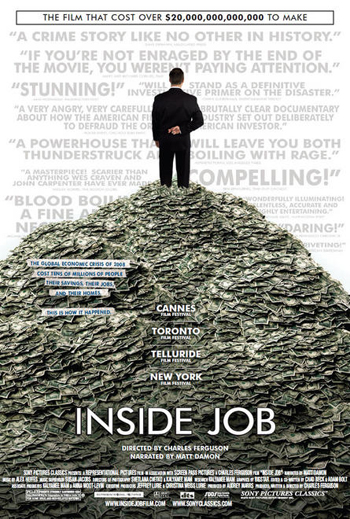
Watch "Inside Job" Online, For Free

I already mentioned this Oscar-winning documentary about the 2008 subprime crisis in a post a couple of months ago. If you have not seen it yet, here's your chance to (legally) see Inside Job online for free, and in high definition.

The film remains importantly relevant to this day as we find ourselves on the cusp of another potential global financial crisis.

Link for Inside Job (can't be embedded, unfortunately)


After watching, we can discuss the film in the comments section below.

Friday, December 16, 2011

5 Reasons Why the Philippines Will Fare Relatively Well in Another Financial Crisis


Last week, I attended a seminar entitled "Can Emerging East Asia Weather Another Global Economic Crisis?" "Emerging East Asia" pertains to the ASEAN 10 (Indonesia, Malaysia, the Philippines, Singapore, Thailand, Brunei, Burma, Cambodia, Laos, and Vietnam), China, Taiwan, Korea, and Hong Kong. Key participants included Mr. Iwan J. Azis, head of ADB's Office of Regional Economic Integration, and representatives from the International Monetary Fund (IMF), the Hong Kong Monetary Authority, Barclays Capital, and the Korea Institute for International Economic Policy. In this post, I will highlight important insights that I gathered from the event and how these will affect the economic prospects of the Philippines in the coming years.

Mr. Azis opened the seminar with a presentation of key points from the Asia Economic Monitor for December 2011. ADB sees that if the debt problem in Europe is not resolved and contained in the coming weeks and months, it may lead to any of the following three scenarios: first, a recession contained to the Eurozone; second, a recession in Europe and, to a lesser degree, in the US; and finally, a full-blown global financial crisis.

Just as in 2008/2009, any one of these situations could result in heightened risk aversion among investors and a sharp drop in global demand for goods and services that would, in turn, adversely affect countries from emerging East Asia to varying degrees. The extent of the damage to any particular economy and the capacity of that economy to recover from the crisis will greatly depend on the following factors:

  • The "health" of the financial/banking sector and its exposure to toxic assets
  • The economy's exposure to European and US banks
  • The economy's dependence on foreign demand (i.e., exports) vis-a-vis local demand
  • The capacity of the economy to enact timely policy responses
In the worst case, ADB forecasts that regional growth will go down by 1.8 percentage points, assuming no policy response from the concerned economies.

How will the Philippines fare compared to other emerging East Asian economies? 

There are indications that the Philippines will fare relatively well in an impending financial crisis.

1. The Philippine banking sector remains conservative, and this will continue to shield us from the brunt of any financial crisis, just as it did in 2008. Also, efforts by the BSP to impose stricter capital requirements, particularly for thrift and rural banks, in the past couple of years further strengthen the banking sector as a whole.

2. The Philippines has a lower exposure to European and US banks compared to other countries in the region.


3. The Philippines has significantly reduced its reliance on US and European trade in the past couple of years.


4. Philippine households have remained financially conservative, especially compared to other economies in the region. Of course, the figures below most probably does not capture informal debt, and so may be understated.


5. (This is just my opinion) The Aquino administration's efforts to hold the previous administration accountable for past transgressions has and will continue to lead to stronger investor confidence.

Although no one particular country was discussed in the seminar, this final slide from ADB clearly supports the conclusion that the Philippines will fare relatively better than other economies in the region in a global economic crisis scenario.


Which should be very good news for most of us, although I'm not particularly ecstatic about all this since most of my investments are here in Hong Kong. Oh well, I guess I would just have to boost my Philippine holdings as much as I can.

As for the question "Can Emerging East Asia Weather Another Global Economic Crisis?", Mr. Azis' answer was straight to the point: "Yes, but we have to prepare for the worst."

And here's a gratuitous shot of Hong Kong harbour from the event location.


Monday, October 3, 2011

Reacting to Concerns about Europe and a Double Dip Recession


I go away for two weeks and see my portfolio down by 10% when I get back? What's a prudent investor to do in such a situation?

In case you have forgotten the things we have talked about in this blog for the past one-and-a-half years (or if you're a new reader), the most important thing to do in situations like this is not to panic and not to sell. Then, if you have both bowels of steel and a bit of extra spending money left, buy to strengthen your position, which is exactly what I did at the end of today's trading session.

It's been close to two months since I said and did pretty much the same things, and the PSEi has been down 9.3% in the same period. If we just spend a couple of moments to think about it, if you believe that two months ago was a good time to buy, then by the very same reasons, today should be a much, much better time to do it.

By most accounts, even if the world economy enters a recession in the coming months, stocks would still be inexpensive by historical standards. This is a sign that investors overreact when they migrate capital from equities to "safer" assets like cash and treasuries. Remember, the best way to make the most out of your capital is to go against the flow and do exactly the opposite of what everyone else is doing.

To help you better rationalize this counter-intuitive way of thinking, dwell on this. Most probably, one of your biggest concerns right now is whether to upgrade to an iPhone 5, get that new Kindle, or maybe finally buy your own car. I would bet that people around you, like your family and close friends, think about similar issues most of the time. My point is that, a European financial crisis and/or a double dip recession notwithstanding, you're doing fine. And so are the corporations that provide you with the things that you need and want. So why would these companies be worth 10% less all of a sudden?

Thursday, September 29, 2011

3 Films about the Financial Crisis

We've been sitting on top of what may be another financial landmine for several weeks now, so I think now's a good a time as any to look back at how global financial crisis of a few years ago came to be. Here are three interpretations of that fateful moment in modern human history, three different looks at a series of events that continue to affect how we think and behave in the world of business and finance to this very day.

1. Too Big to FailThe Hollywood Treatment


The plot revolves around former US Secretary of the Treasury Henry "Hank" Paulson (played by William Hurt) and how he and his team handled the crisis, from JP Morgan's acquisition of Bear Stearns to the bankruptcy of Lehman Brothers, up to the moment he and Ben Bernanke developed and proposed the bailout program to the US congress.

2. Inside Job - An Angry Documentary


This documentary by filmmaker Charles Ferguson and narrated by Matt Damon won the Oscar for Best Documentary in 2011. Here, Paulson and his fellow Wall-Street-to-Washington compadres were painted in a less flattering light than in Too Big. While most of the more prominent figures in the middle of events (e.g., Paulson, Tim Geithner, Larry Summers, etc.) declined to participate in the film, it did not lack for important insights and comments from several people who were in the know. One particularly interesting angle that the film looked at is the degree of complicity of the academe in igniting and perpetuating the crisis. It also presents a "user friendly" explanation for how the crisis came about, similar to those we presented in this blog previously.

3. Inside the Meltdown - The Sane Take


Inside the Meltdown is an episode from PBS's FRONTLINE series; you can view the full program online here. It covers more or less the same period that Too Big does, but without the drama, and is several degrees more objective than Inside Job. Needless to say, if you must choose only one among these three, choose this.

Saturday, August 6, 2011

After 70 Years, the US Loses AAA Credit Rating

IN THE NEWS from Reuters


Ratings agency Standard & Poors has just downgraded the credit rating of the United States from AAA to AA+ amid concerns about the country's debt problems and shaky economic outlook. The move comes a few days after US lawmakers reached an agreement to address the government's worsening budget troubles and a day after the worst US stock market decline since the 2008 financial crisis.

Implications for the US

The credit rating downgrade signifies an increase in the perceived riskiness of the financial securities issued by the US and reflects concerns that the recent debt deal might not be able to resolve the country's medium-term fiscal woes. There has been widespread clamor from various sectors to include provisions that will increase taxes for the wealthiest Americans, a detail that US lawmakers have agreed not to include in the deal. The downgrade effectively increases the cost of borrowing of the US (remember, higher risk, higher return), devaluing its outstanding bond issues and increasing the interest rate on all future debt issues.

Implications for everyone else

Apart from an initial negative reaction by international markets on Monday, the move is expected not to have much of a global impact. Then again, the way these things go, no one can ever really say for certain. We all just have to wait for how things will unfold in a couple of days and be ready to pounce on any opportunity that may arise.

Tuesday, August 2, 2011

Countdown to Extinction, Part 3: The End of the End... Or Is It?

IN THE NEWS from Post-Tribune


The impasse is finally over. After weeks of political posturing and endless debates, the US House of Representatives finally passes a bill that addresses the country's pressing debt concerns. The US Senate is expected to ratify the bill at noon on August 2, US time, and be signed into law by President Obama soon after.

Bad news for those who are wishing for another crisis, and good news for everyone else? Maybe.

Apart from increasing the US government's debt limit to avoid default, the deal also includes provisions to decrease government spending by US$$ 2.1 trillion spread over 10 years. However, some experts point out that while the bill may adequately address the US's immediate fiscal issues, it may not be enough to make any lasting difference since it does not involve any attempt to increase revenues (by repealing tax cuts implemented during the Bush administration, for example). The US government survives this one, yes, if only barely, but there's no reason to celebrate yet... not by a long shot.

Asian markets reacted favorably to early news of an agreement between Democrats and Republicans, with sharp price increases at yesterday's trading. More realistic expectations about the goings on in the US may have just sunk in today, however, as the Hang Seng Index in Hong Kong and the PSEi in the Philippines suffer losses as of this writing (noon of August 2), wiping out gains made the previous day.

UPDATE: 08/03/2011, 11:00 AM

President Barack Obama signs the debt ceiling bill into law


UPDATE: 08/03/2011, 12:30 PM

Fault Lines: The Top 1% - A very relevant documentary from Al Jazeera


Saturday, July 30, 2011

Countdown to Extinction, Part 2: What They're Doing About It and What It Means For Us


The short term solution to this predicament is for the US to borrow more; the problem is that additional debt would push borrowing beyond the current debt ceiling or limit of US$ 14.3 trillion, and the only workaround is to legislate an increase in the debt ceiling. To improve the US's financial situation in the medium to long term, spending cuts and/or tax increases would also have to be enacted by Congress. Seems straightforward enough, right? So why have these things not been done yet? Two words: partisan politics. The only way a solution could be legislated is if Democrats and Republicans work together and agree on a solution; unfortunately, to this date, the two parties continue to bicker, pontificate, push for their own agendas and refuse to compromise.


As the deadline draws near and an agreement still nowhere in sight, many of us rightfully wonder what this might mean for us, both as investors and ordinary Filipinos. Might as we want to believe that we are immune to the effects of the stupidity of *some* Americans, the 2008 financial crisis has shown us that we are not. I repeat here some of the ways I think we could be affected by a US default that I have already stated in the comments section of the previous post.
  • A default would trigger a rating downgrade on US debt, and this will raise interest rates on future borrowings. I've read somewhere that a 1% increase in interest rate will result in an additional US$ 100 billion in interest payments; this additional financial strain could trigger a recession/depression in the US. 
  • The US is our number one trading partner; a decline in US demand due to the contraction of their economy will lead to a drop in our exports to the US, and this, in turn, will negatively affect both our general economy and the revenues of specific export-reliant industries and firms. 
  • US demand for services in the Philippines will decline and related industries like call centers will also be hit.
  • As soon as the phrase "financial crisis" gets out to mainstream media, people will start to panic and take their money out of the stock market, causing a substantial drop in stock prices.
Given these dire possible effects of a US default on our economy, how concerned should we be? Is now the time to panic? The consensus that a US default would lead to disastrous global economic consequences is matched only by the widespread agreement that a US default will not happen and that eventually these stubborn US representatives will realize the folly of their actions and finally act for the interests of their constituents, as they should have done from the very beginning. Everyone is saying that one way or another, the US government will not default on its debt, so there's no real reason to panic. But that doesn't mean that we should not prepare ourselves for what could happen.

Thursday, July 28, 2011

Countdown to Extinction, Part 1: Wanna See How Screwed the US's Finances Really Are?

It's hard to imagine how the the biggest economy in the world--and since time immemorial what we Filipinos have considered as the land of promise and endless opportunity--would find itself facing a very real and imminent financial shit fest (for lack of a more suitable term, please pardon my French). For those who don't know yet, the US is broke: broke, not figuratively but for real, broke as in it does not have enough money to pay for stuff it needs. Yes, broke broke. Wait, let me correct that, I'm getting ahead of myself: at least according to Slate, the US will officially run out of money on August 3 (that's one, two... seven days from today, US time), that is unless the US Congress gets its act together by August 2, but that's a story for another post (the last post of July, to be exact). For now, let's just see how screwed up the US financial situation really is with these graphs from the same article from Slate.

First, the state of the US's cash reserves, which shows how money could dry up by August 3.


And finally, a look at the US's debt position, which illustrates a Catch-22-like situation: the US is running out of money to pay its bills and debt obligations, so it needs to borrow more, but the more it borrows, the more money it needs to pay it's existing and new creditors.


All this makes the next few days both scary and exciting for investors like you and I as all eyes are on how the US Congress will handle the situation. And while now is not the time to panic, it is definitely time to act. What we all can do is hedge our bets by cashing in our paper gains now and build up an ample hoard of cash that we can use to take advantage of a buying opportunity if the shit does hit the fan next week.

UPDATE: 7/29/2011, 4:30 PM

Something that will help us better understand how it came to this.


An additional US$ 4.3 trillion in two years brings us up to speed.

Related Posts Plugin for WordPress, Blogger...