Tuesday, December 27, 2011

GMA 7 is on MVP's Christmas Wish List

FROM THE RUMOR MILL

Are You Ready for the "Kaputid" Network?

I got this off one of my contacts in Facebook. Rumor has it that Manny V. Pangilinan, a.k.a. "MVP", has made an offer to the Duavit, Gozon, and Jimenez families for GMA 7, and that the offer figure is so "mind-boggling" that it's "impossible to counter." And if you think Ruffa Gutierrez is a reliable source, then it seems that this already is a done deal.


Haven't we seen a similar move from MVP months ago with the PLDT-Digitel merger? If the offer is true and if a deal does materialize, it would be interesting to see the following unfold in the next few days:

  • How much premium MVP is willing to pay to own the undisputed number one network in the country
  • If ABS-CBN would go the same way as Globe and try to block the deal (and how much political clout the Lopezes still have left)
  • How the stock prices of affected players (e.g., PLDT, GMA, ABS-CBN) would be affected 

If the offer is indeed as high as rumored, then we should see significant short-term gains for GMA (up around 5% as of this writing) and possibly a short term drop for PLDT (down around 0.08% as of this writing). If the tremendous growth of TV5 since MVP took control in 2008 is any indication, then a GMA7-TV5 "alliance" should eventually bear significant fruits in the long run; whether this additional value is worth more than the premium paid for the acquisition is another question altogether.

As for ABS-CBN, just like with Globe in the PLDT-Digitel merger, some would argue that the move will also benefit the second player since industry consolidation would decrease competition for the entire industry and all its players. Frankly, I'm not a really big fan of the network and I think I pretty much loath everything the "kapamilya" network comes to represent. Ever since the Lopezes regained control of ABS-CBN in 1986 from Marcos's cronies, it had been in the best position to innovate and provide high quality entertainment for Filipinos, but what it did in the next 25 years was serve regurgitated crap that just made everyone dumber. Anyway, enough about that; I just hope that with this additional pressure will force ABS-CBN finally try to live up to its promise.

***

UPDATE 28 December 2011, 2:22 PM via PhilSTAR.com

GMA has just denied the rumor:

“There is no truth to the rumor ongoing around in social media sites and the Internet that Mr. Pangilinan has bought GMA Network. In fact, there is no negotiation going on between GMA and Mr. Pangilinan regarding the latter’s acquisition of GMA-7.”

And now we know what the rumored "mind-boggling" offer is: 500 billion pesos, or 25 times GMA's current market capitalization of around 20 billion . Wow. Yeah, that can't be right.

GMA 7 shares are down around 0.5% today.

Saturday, December 24, 2011

1st Annual Holiday Rant 2011: Societal Trust

Episode One: Robinson's Pioneer

After spending a couple of days in Manila to meet some friends, I asked my sister to pick me up and take me to our parents’ place in Bulacan. I would have gone on my own, if I could, but I had this sealed big box of presents with me from Hong Kong. I already anticipated that I might be hassled by the guards when I enter the mall with all my stuff, but I really hoped that I would be able to charm them or at least reason with them.

As it turned out, I did not have any problem going inside the mall: I was able to reassure the lady guard that I was just carrying a box of gift toys and sweet talk her out of asking me to open it. Unfortunately, this same strategy turned out to be ineffective with another guard that I encountered a bit later. As I was waiting for my sister near the exit to the parking lot, another lady guard approached me out of nowhere and asked what I had in the box. In my sweetest tone, I answered “toys for my nephews and nieces” and explained that I already talked to the other guard about it. Still, she insisted that I open the box, and since by then I was already too tired to argue, I promptly ripped the box open (it was sealed, and I did not have a knife or any sharp object with which to open the box properly). When she saw the various boxes of toys inside the bigger box, she walked away with nary a word (I can only imagine how it would have turned out had I wrapped my gifts before flying to Manila).

Episode Two: SM Marilao

The other day I went out for last-minute gifts. I quickly bought a couple of Transformers movie toys from Toy Kingdom, then headed to the supermarket for a few supplies. As I was about to enter, the guard nonchalantly stopped me and asked me to “check in” my Toy Kingdom plastic bag. I was really surprised that she asked me to do this—the bag was small as it only contained two card-backed Transformers toys—so I asked her why I had to do this. She simply said that my toys might get mixed with my other purchases—or something to that effect—but instead of saying “so what?” as I probably should have, I just walked away.

So what?

I was not really angry at these guards: while some guards could really turn up the power trip at times, ultimately they’re still just doing what they were told by higher ups. Well, maybe I was a bit pissed, not at them, but at these attempts to improve security and address threats to peace and order, because by now we all know that these efforts don’t work and just waste people’s time and resources; these policies were presumably designed for our benefit and interest as ordinary Filipinos but in truth are implemented at our expense. But mostly I was saddened because I realize that these practices just end up sowing a deeper, darker cloud of mistrust in Filipino society.

Trust

According to Francis Fukuyama,

“A nation's well being, as well as its ability to compete, is conditioned by a single, pervasive cultural characteristic: the level of trust inherent in society.”


The successful consummation of every economic transaction is heavily dependent on how each party trusts the other to behave as expected since contracts can only address so many details and possibilities. Trust can also provide significant additional value to businesses by minimizing transaction and monitoring costs. So maybe it’s no coincidence that some of the most developed countries in the world trust their citizens enough so that individuals are not asked to open sealed boxes inside malls or open bags when entering train stations.

Some of you may point out that it’s a small price to pay for security—or at least, a sense of security—and I will have agreed if indeed these policies make us feel safer, but they don’t. Some of you may say that I’m just being petty and making too much fuss about nothing and I will have agreed were the amount of economic resources wasted on such practices trivial, but it isn’t.

I’m not trying to be a defeatist or an alarmist, because really, if this season means anything to me, it’s that things can always get better and that sometimes they do. Maybe what this post is really about, apart from being a venue for my rant, is how to convince ourselves to try to trust each other more, because really, no matter how bright and honest our president and all our leaders are, as long as we don’t trust the ordinary Filipino enough to just leave him be, let him do his business, and not think he will shoplift or set a bomb at the next opportunity, our nation will find it very hard to become great again.

Of course this is only possible if we become more trustworthy ourselves. Trust and trustworthiness is a chicken and egg thing, although knowing which one comes first matters less than actually getting the cycle started.

And it starts with me, of course.

Happy holidays, everyone. :)

Thursday, December 22, 2011

Watch "Inside Job" Online, For Free

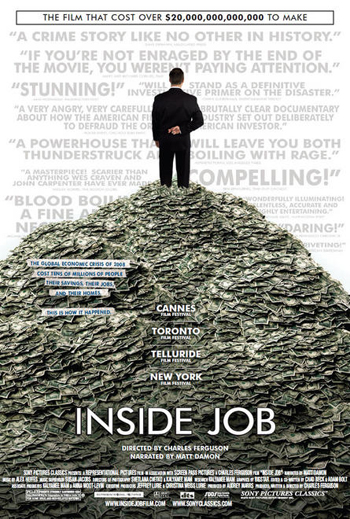
I already mentioned this Oscar-winning documentary about the 2008 subprime crisis in a post a couple of months ago. If you have not seen it yet, here's your chance to (legally) see Inside Job online for free, and in high definition.

The film remains importantly relevant to this day as we find ourselves on the cusp of another potential global financial crisis.

Link for Inside Job (can't be embedded, unfortunately)


After watching, we can discuss the film in the comments section below.

Friday, December 16, 2011

5 Reasons Why the Philippines Will Fare Relatively Well in Another Financial Crisis


Last week, I attended a seminar entitled "Can Emerging East Asia Weather Another Global Economic Crisis?" "Emerging East Asia" pertains to the ASEAN 10 (Indonesia, Malaysia, the Philippines, Singapore, Thailand, Brunei, Burma, Cambodia, Laos, and Vietnam), China, Taiwan, Korea, and Hong Kong. Key participants included Mr. Iwan J. Azis, head of ADB's Office of Regional Economic Integration, and representatives from the International Monetary Fund (IMF), the Hong Kong Monetary Authority, Barclays Capital, and the Korea Institute for International Economic Policy. In this post, I will highlight important insights that I gathered from the event and how these will affect the economic prospects of the Philippines in the coming years.

Mr. Azis opened the seminar with a presentation of key points from the Asia Economic Monitor for December 2011. ADB sees that if the debt problem in Europe is not resolved and contained in the coming weeks and months, it may lead to any of the following three scenarios: first, a recession contained to the Eurozone; second, a recession in Europe and, to a lesser degree, in the US; and finally, a full-blown global financial crisis.

Just as in 2008/2009, any one of these situations could result in heightened risk aversion among investors and a sharp drop in global demand for goods and services that would, in turn, adversely affect countries from emerging East Asia to varying degrees. The extent of the damage to any particular economy and the capacity of that economy to recover from the crisis will greatly depend on the following factors:

  • The "health" of the financial/banking sector and its exposure to toxic assets
  • The economy's exposure to European and US banks
  • The economy's dependence on foreign demand (i.e., exports) vis-a-vis local demand
  • The capacity of the economy to enact timely policy responses
In the worst case, ADB forecasts that regional growth will go down by 1.8 percentage points, assuming no policy response from the concerned economies.

How will the Philippines fare compared to other emerging East Asian economies? 

There are indications that the Philippines will fare relatively well in an impending financial crisis.

1. The Philippine banking sector remains conservative, and this will continue to shield us from the brunt of any financial crisis, just as it did in 2008. Also, efforts by the BSP to impose stricter capital requirements, particularly for thrift and rural banks, in the past couple of years further strengthen the banking sector as a whole.

2. The Philippines has a lower exposure to European and US banks compared to other countries in the region.


3. The Philippines has significantly reduced its reliance on US and European trade in the past couple of years.


4. Philippine households have remained financially conservative, especially compared to other economies in the region. Of course, the figures below most probably does not capture informal debt, and so may be understated.


5. (This is just my opinion) The Aquino administration's efforts to hold the previous administration accountable for past transgressions has and will continue to lead to stronger investor confidence.

Although no one particular country was discussed in the seminar, this final slide from ADB clearly supports the conclusion that the Philippines will fare relatively better than other economies in the region in a global economic crisis scenario.


Which should be very good news for most of us, although I'm not particularly ecstatic about all this since most of my investments are here in Hong Kong. Oh well, I guess I would just have to boost my Philippine holdings as much as I can.

As for the question "Can Emerging East Asia Weather Another Global Economic Crisis?", Mr. Azis' answer was straight to the point: "Yes, but we have to prepare for the worst."

And here's a gratuitous shot of Hong Kong harbour from the event location.


Tuesday, December 13, 2011

Decision Making According to Economists, Part 2: Diminishing Marginal Utility

Let's go back to where we left off in Part 1.

In a game of chance, you pay a fixed fee to enter, and then a fair coin will be tossed repeatedly until a tail first appears, ending the game. The pot starts at 1 peso and is doubled every time a head appears. You win whatever is in the pot after the game ends. Thus you win 1 peso if a tail appears on the first toss, 2 pesos if on the second, 4 pesos if on the third, 8 pesos if on the fourth, etc. In short, you win 2^(k − 1) pesos if the coin is tossed k times until the first tail appears.

What would be a fair price to pay for entering the game?

We can estimate the "fair price" of this game using expected value, for which we need the payoffs and probabilities that correspond to each state of nature.

The game could end after the following number of tosses:

1   2   3   4  5   ...   k   k + 1   ...

Please note that it is possible (although, of course, very improbable) that the game would go on indefinitely.

The payoffs for these possible outcomes are as follows:

1   2   4   8   16   ...   2^(k -1) ...   2^k   ...

Now we turn to the probabilities. For the first outcome, the probability of getting a tail on the first toss is 1/2. For the second outcome, you'll need to toss heads then tails, for which the probability is 1/4. The third outcome consists of heads, heads, and tails, and the probability is 1/8. So now, we should see that the pattern of probabilities is:

1/2   1/4   1/8   1/16   1/32   ...   1/(2^k)   ...   1/(2^(k + 1))   ...

The expected value of an alternative is just the weighted average of the payoffs, using probabilities as weights. Therefore, the expected value of playing the game is:

1*1/2 + 2*1/4 + 4*1/8 + 8*1/16 + 16*1/32 + 2^(k - 1)*(1/(2^k)) + 2^k*(1/(2^(k + 1))) + ...
= 1/2 + 1/2 + 1/2 + 1/2 + 1/2 + 1/2 + 1/2 + ...
= infinity

(Kudos to reader "Maykee" for getting it right, and thanks to everyone who tried.)

So, would you pay that much to play the game? How about something significantly less than infinity, like say, 1 million pesos? It does not sound so attractive, right? In fact, I'll bet that you'll even have trouble finding someone who's willing to play the game for 100 pesos (how many tosses would it take to win more than this?). This is why people have referred to this game as a paradox--the St. Petersburg Paradox, to be precise.

The game was invented by Nicolaus Bernoulli, nephew of the Bernoulli that we encountered in Part 1. "St. Petersburg" does not pertain in any way to Nicolas, however, but very interestingly to the work of another famous Bernoulli, his cousin Daniel. According to Daniel Bernoulli, it is not appropriate to use expected value to solve the problem since

The determination of the value of an item must not be based on the price, but rather on the utility it yields…. There is no doubt that a gain of one thousand ducats (some form of ancient money) is more significant to the pauper than to a rich man though both gain the same amount.

Daniel Bernoulli
What is utility? In its most basic sense utility is the satisfaction or benefit that one gets from choosing or doing something. Economists want to play safe, however, and just say that utility is that something which makes decision makers choose one thing over another. And Daniel Bernoulli's simple idea--that of diminishing marginal utility--revolutionized the study of economics and decision making in the next couple of centuries.

Diminishing marginal utility means that the utility that one gets from receiving or consuming one unit of something--be it pesos, ducats, fame, or beer--decreases as one amasses more and more of that something. It explains why the first bottle of beer tastes oh-so-much better than your fifth, and why receiving a 5,000 peso bonus when you're just earning 10,000 pesos a month is more satisfying than receiving the same amount when you're already a millionaire.

This concept is also very important in finance because it defines a decision maker's attitude towards risk. An individual for whom a particular reward has diminishing marginal utility is risk averse with respect to that reward: he or she is the stereotypical decision maker in economics, someone who is willing to pay to avoid a very small probability of a big loss (e.g., someone who buys insurance)--that is, how most of us usually are. Someone for whom the same reward has increasing marginal utility, on the other hand, may be seen as risk seeking, like someone who will pay just to have even a small chance of winning something big (e.g., someone who plays the lottery)--that is, how most of us are in certain situations, sometimes.

Going back to the game, if we assume that for a typical player the game's prize has diminishing marginal utility and that this utility is a slowly increasing function of the player's initial wealth plus his winnings, then the utility of the additional payoff from a toss of heads will be smaller than the utility of the one that came before, which should result in a finite fair price.

I know a lot of you have already had your fill of theoretical mumbo jumbo this past month, so we'll get back to more practical matters in the next post. :)

Related Posts Plugin for WordPress, Blogger...