Showing posts with label Making Decisions. Show all posts

Tuesday, July 3, 2012

Monty Hall

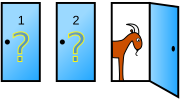
The situation that I presented in the Quickie Problem post last week is popularly known as The Monty Hall Problem, where "Monty Hall" is the name given to the host of the fictional game show in most versions. I'll repost the problem here for those who missed it:

Suppose you're on a game show and you're given the choice of three doors (and will win what is behind the chosen door). Behind one door is a car; behind the others, goats. The car and the goats were placed randomly behind the doors before the show. The rules of the game show are as follows: After you have chosen a door, the door remains closed for the time being. The game show host, who knows what is behind the doors, now has to open one of the two remaining doors, and the door he opens must have a goat behind it. If both remaining doors have goats behind them, he chooses one at random. After the host opens a door with a goat, he will ask you to decide whether you want to stay with your first choice or to switch to the last remaining door. Imagine that you chose Door 1 and the host opens Door 3, which has a goat. He then asks you "Do you want to switch to Door Number 2?" Is it to your advantage to change your choice?

The correct answer is that it's to your advantage to switch doors (that is if you prefer a car over a goat), as was stated by a couple of readers in the post, although it's very hard to understand and accept why (even with the "solution" given by the movie "21"). There are more than a few ways to arrive at the correct answer, but from my research this short video clip presents the simplest and most understandable explanation.


Remember that the key to the solution--the detail that makes switching the best move--is that the host knows where the car is and always chooses a door with a goat to open.

The best thing about the videos, though, are the comments, which are indisputable proof that trolls and idiots abound online.

Friday, June 29, 2012

Quickie Problem

Suppose you're on a game show and you're given the choice of three doors (and will win what is behind the chosen door). Behind one door is a car; behind the others, goats. The car and the goats were placed randomly behind the doors before the show. The rules of the game show are as follows: After you have chosen a door, the door remains closed for the time being. The game show host, who knows what is behind the doors, now has to open one of the two remaining doors, and the door he opens must have a goat behind it. If both remaining doors have goats behind them, he chooses one at random. After the host opens a door with a goat, he will ask you to decide whether you want to stay with your first choice or to switch to the last remaining door. Imagine that you chose Door 1 and the host opens Door 3, which has a goat. He then asks you "Do you want to switch to Door Number 2?" Is it to your advantage to change your choice?


Please spend some time to think about the problem and try not to google the solution; feel free to discuss in the comments section. I will post the solution next week. Have a great weekend everyone!

Friday, May 11, 2012

Solving Prisoner's Dilemma

Many of us probably first encountered game theory from the 2001 film A Beautiful Mind where the Nobel-economist John Nash, played by Russel Crowe, showed us that "every man for himself" may not be the best strategy in picking up girls in a bar.


Game theory has a couple of advantages over other approaches in studying decision making. First, it recognizes that the consequences (e.g., payoffs) of the decision of one player are affected by the decisions of other players. And second, it acknowledges that in the real world, players often have to make decisions simultaneously and that waiting for other players to make their move and just react is not possible (or practical).

In this post we will take another look at the "prisoner's dilemma" game that I introduced in the previous post and try to come up with a methodological solution that you may or may not agree with.

Two men are arrested, but the police do not possess enough information for a conviction. Following the separation of the two men, the police offer both a similar deal—if one testifies against his partner (defects/betrays), and the other remains silent (cooperates/assists), the betrayer goes free and the cooperator receives the full one-year sentence. If both remain silent, both are sentenced to only one month in jail for a minor charge. If each 'rats out' the other, each receives a three-month sentence. Each prisoner must choose either to betray or remain silent; the decision of each is kept quiet. What should they do?

We can summarize the payoffs for two prisoners A and B as follows:


One approach in arriving at a solution to this game is to identify dominant and dominated strategies. A dominant strategy is one which dominates all other strategies: that is, it is the best move for a particular player regardless of what the other player does. For example, in the prisoner's dilemma game, if Prisoner B keeps silent, the best move for A is to betray Prisoner B; if Prisoner B betrays A, then it would be best if Prisoner A betrays B. These arguments show us that "betray" is a dominant strategy for A, and following the same reasoning, also for B. By eliminating the dominated strategies (keeping silent for each prisoner), we are left with one solution: for the two prisoners to betray each other and be sentenced to three months each.


Do you agree with this solution? I'm sure that a lot of you don't. The problem with the dominant strategy approach is that it (implicitly) excludes the option to cooperate or collude. But as John Nash (in the movie) and that player from Golden Balls showed us, if players work together, each will be able to receive the best payoffs for himself and the group: everyone will get laid!

Monday, May 7, 2012

Let's Play Golden Balls


Imagine the following situation:

Two men are arrested, but the police do not possess enough information for a conviction. Following the separation of the two men, the police offer both a similar deal—if one testifies against his partner (defects/betrays), and the other remains silent (cooperates/assists), the betrayer goes free and the cooperator receives the full one-year sentence. If both remain silent, both are sentenced to only one month in jail for a minor charge. If each 'rats out' the other, each receives a three-month sentence. Each prisoner must choose either to betray or remain silent; the decision of each is kept quiet. What should they do?

If you were one of the arrested men, would you betray your partner or remain silent? If you were just an observer, what do you think should the two arrested individuals do?

Golden Balls is a game show in the UK that places two contestants (after a couple of "elimination" rounds) in a similar situation. Given a jackpot amount that was determined in earlier rounds, contestants given two golden balls, one with the word SPLIT printed inside and the other with the word STEAL printed inside. They are then asked to secretly choose a ball. Each contestant's winnings are determined by the following rules:
  • If both contestants choose a SPLIT ball, the jackpot is split equally between them.
  • If one contestant chooses a SPLIT ball and the other chooses a STEAL ball, the "stealer" gets all the money and the "splitter" gets nothing.
  • If both contestants choose STEAL balls, they both get nothing.
The players have a chance to speak with each other face to face before making their choices.

If you were one of the contestants, how would you play the game? If you want to see one of the better ways to do it, watch this video.


The two situations above represent a problem called prisoner's dilemma, a classic example of game theory--which is a method of studying how people, businesses, and other entities make decisions. In a follow-up post, I will discuss a proposed solution to the prisoner's dilemma problem and we'll see how this solution agrees to or differs from how you and I will play the game.

Tuesday, December 13, 2011

Decision Making According to Economists, Part 2: Diminishing Marginal Utility

Let's go back to where we left off in Part 1.

In a game of chance, you pay a fixed fee to enter, and then a fair coin will be tossed repeatedly until a tail first appears, ending the game. The pot starts at 1 peso and is doubled every time a head appears. You win whatever is in the pot after the game ends. Thus you win 1 peso if a tail appears on the first toss, 2 pesos if on the second, 4 pesos if on the third, 8 pesos if on the fourth, etc. In short, you win 2^(k − 1) pesos if the coin is tossed k times until the first tail appears.

What would be a fair price to pay for entering the game?

We can estimate the "fair price" of this game using expected value, for which we need the payoffs and probabilities that correspond to each state of nature.

The game could end after the following number of tosses:

1   2   3   4  5   ...   k   k + 1   ...

Please note that it is possible (although, of course, very improbable) that the game would go on indefinitely.

The payoffs for these possible outcomes are as follows:

1   2   4   8   16   ...   2^(k -1) ...   2^k   ...

Now we turn to the probabilities. For the first outcome, the probability of getting a tail on the first toss is 1/2. For the second outcome, you'll need to toss heads then tails, for which the probability is 1/4. The third outcome consists of heads, heads, and tails, and the probability is 1/8. So now, we should see that the pattern of probabilities is:

1/2   1/4   1/8   1/16   1/32   ...   1/(2^k)   ...   1/(2^(k + 1))   ...

The expected value of an alternative is just the weighted average of the payoffs, using probabilities as weights. Therefore, the expected value of playing the game is:

1*1/2 + 2*1/4 + 4*1/8 + 8*1/16 + 16*1/32 + 2^(k - 1)*(1/(2^k)) + 2^k*(1/(2^(k + 1))) + ...
= 1/2 + 1/2 + 1/2 + 1/2 + 1/2 + 1/2 + 1/2 + ...
= infinity

(Kudos to reader "Maykee" for getting it right, and thanks to everyone who tried.)

So, would you pay that much to play the game? How about something significantly less than infinity, like say, 1 million pesos? It does not sound so attractive, right? In fact, I'll bet that you'll even have trouble finding someone who's willing to play the game for 100 pesos (how many tosses would it take to win more than this?). This is why people have referred to this game as a paradox--the St. Petersburg Paradox, to be precise.

The game was invented by Nicolaus Bernoulli, nephew of the Bernoulli that we encountered in Part 1. "St. Petersburg" does not pertain in any way to Nicolas, however, but very interestingly to the work of another famous Bernoulli, his cousin Daniel. According to Daniel Bernoulli, it is not appropriate to use expected value to solve the problem since

The determination of the value of an item must not be based on the price, but rather on the utility it yields…. There is no doubt that a gain of one thousand ducats (some form of ancient money) is more significant to the pauper than to a rich man though both gain the same amount.

Daniel Bernoulli
What is utility? In its most basic sense utility is the satisfaction or benefit that one gets from choosing or doing something. Economists want to play safe, however, and just say that utility is that something which makes decision makers choose one thing over another. And Daniel Bernoulli's simple idea--that of diminishing marginal utility--revolutionized the study of economics and decision making in the next couple of centuries.

Diminishing marginal utility means that the utility that one gets from receiving or consuming one unit of something--be it pesos, ducats, fame, or beer--decreases as one amasses more and more of that something. It explains why the first bottle of beer tastes oh-so-much better than your fifth, and why receiving a 5,000 peso bonus when you're just earning 10,000 pesos a month is more satisfying than receiving the same amount when you're already a millionaire.

This concept is also very important in finance because it defines a decision maker's attitude towards risk. An individual for whom a particular reward has diminishing marginal utility is risk averse with respect to that reward: he or she is the stereotypical decision maker in economics, someone who is willing to pay to avoid a very small probability of a big loss (e.g., someone who buys insurance)--that is, how most of us usually are. Someone for whom the same reward has increasing marginal utility, on the other hand, may be seen as risk seeking, like someone who will pay just to have even a small chance of winning something big (e.g., someone who plays the lottery)--that is, how most of us are in certain situations, sometimes.

Going back to the game, if we assume that for a typical player the game's prize has diminishing marginal utility and that this utility is a slowly increasing function of the player's initial wealth plus his winnings, then the utility of the additional payoff from a toss of heads will be smaller than the utility of the one that came before, which should result in a finite fair price.

I know a lot of you have already had your fill of theoretical mumbo jumbo this past month, so we'll get back to more practical matters in the next post. :)

Tuesday, December 6, 2011

Decision Making According to Economists, Part 1: The Expected Value Criterion

In a previous post, I introduced two approaches in studying how people make decisions. In this post, I will discuss the first of these approaches in greater detail: normative decision making.

The normative or prescriptive approach deals with how people should make decisions: it looks at decision making from the point of view of an ideal decision maker--one who is fully informed, able to compute with perfect accuracy, and fully rational--in a environment where information about all available alternatives are known. The normative approach is generally quantitative and involves formulas that range from the basic to the insanely incomprehensible, and thus usually falls within the exclusive purview of economists and mathematicians. The first important normative decision making criteria--expected value--shall be the focus of this post.

Making decisions using expected value

The scenario below illustrates a typical decision problem

ABC Realty has recently purchased land for the development of a new luxury condominium complex. ABC is in the process of selecting the size of the project that will lead to the largest profit given the uncertainty of the demand for condominiums.

Using the four steps in making good decisions that we discussed previously, let's take a closer look at the details of this problem.

1. Identify all available alternatives. ABC needs to choose the size of the condominium project. Let's say the following alternatives are available:

d1 = a small condominium complex
d2 = a medium condominium complex
d3 = a large condominium complex

3. Identify uncontrollable or unpredictable circumstances that may affect the payoffs of alternatives. The project's profits will be affected by the demand for condominiums. Since these possible occurrences, referred to as states of nature, are beyond the control of the decision maker, they are just assigned likelihoods or probabilities. For example, let's say that according to ABC's analysts, there is an 80% chance that demand for condominiums in the foreseeable future will be strong and a 20% chance that it will be weak, or

probability of strong demand = P(s1) = 80%
probability of weak demand = P(s2) = 20%

It should be pointed out that since s1 and s2 cover all possibilities for the demand for condominiums, P(s1) and P(s2) should sum to 1 or 100%.

2. Determine the costs and benefits of alternatives. Both ABC's choice for the size of the project and the demand for condominiums would affect the project's profits or payoffs, which are presented in the following table


We see from this payoff table that the decision is not straightforward since the best alternative--the one with the highest payoff--changes with the demand for condominiums: whereas a large complex would take advantage of strong demand, it would lead to losses if demand turns out to be weak because of (presumably) the higher cost of construction.

4. Evaluate alternatives using some criteria or rule and make a decision. One commonly used criterion in making a decision given the information presented above is the expected value criterion.

The expected value of an alternative is the weighted average of its payoffs under different states of nature, using the probabilities as weights

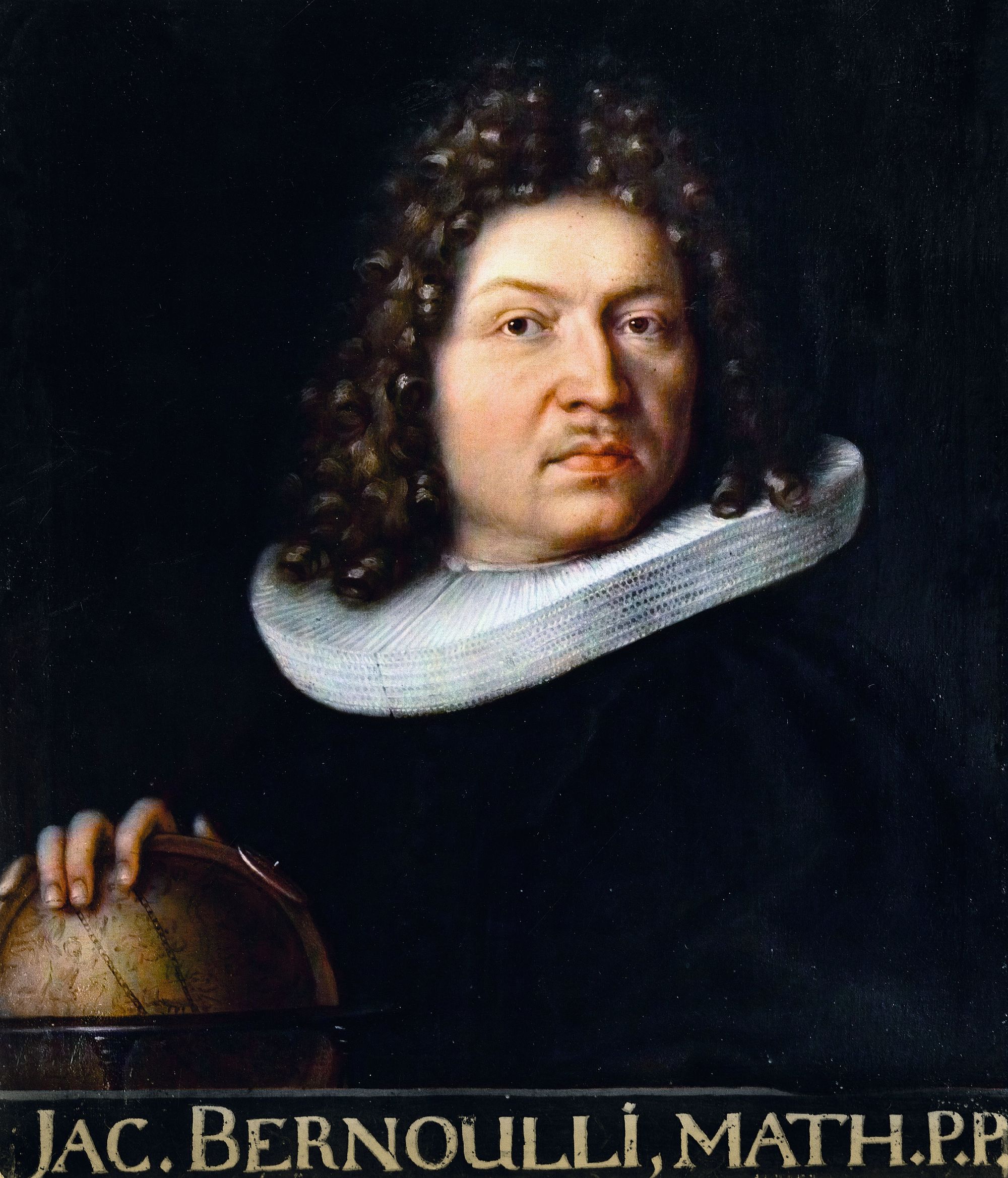
This concept was first formalized in Jakob Bernoulli's groundbreaking work, Ars Conjectandi, published in 1713.

Jakob Bernoulli
We compute for the expected value of each alternative as follows


According to this rule, since alternative d3 or building a large condominium complex results in the highest expected value, ABC should choose this alternative.

While the expected value rule does make a lot of practical sense, we should be careful in interpreting the numbers that result from our analysis. An expected value of 14.2 million does not mean ABC will earn that much if it decides to build a large complex: ABC will either earn 20 million or lose 9 million depending on what demand for condominiums will be. 14.2 million is ABC's average profit if it faces this scenario several times and makes the same decision to build a large complex each time; in other words, it's what ABC stands to earn in the long run.

Expected value in practice

The most common practical application of the expected value concept that I can think of is in gambling, particularly in poker. If you play the Texas Hold'em variety or any similar variant, you may have heard of this strategy rule: join the game if the probability of making one of your outs (i.e., your number of outs divided by the number of cards remaining) times the pot is greater than the required bet. The first part of this rule--the probability of making one of your outs times the pot--is the expected value or payoff of joining the game, so if this is higher than the cost of joining, then it makes sense to call the bet.


Something to think about

We'll end this post with something that has puzzled the greatest minds for the longest time until it led to another groundbreaking concept in the study of decision making, which will be the topic of Part 2 of this post.

Think about this scenario for a while.

In a game of chance, you pay a fixed fee to enter, and then a fair coin will be tossed repeatedly until a tail first appears, ending the game. The pot starts at 1 peso and is doubled every time a head appears. You win whatever is in the pot after the game ends. Thus you win 1 peso if a tail appears on the first toss, 2 pesos if on the second, 4 pesos if on the third, 8 pesos if on the fourth, etc. In short, you win 2^(k−1) pesos if the coin is tossed k times until the first tail appears.

What would be a fair price to pay for entering the game? Read Part 2 to find out.

Thursday, November 24, 2011

How to Make Good Decisions


Contrary to what some of you might think, understanding how people make decisions is an important aspect of successful investing and is thus very relevant to the main thrust of this blog. If we think about it, "investing" really is just a series of "buy" and "sell" decisions, specifically: what assets to buy or invest in, when to invest, and eventually, when to sell. Also, understanding the psychology of the typical investor--how the "crowd" thinks and how it reacts to shocks and new information--is key in devising an effective investment strategy. Finally, the ideas that I present and discuss in this space may actually also be applied to decisions of all kinds, from the mundane (e.g., how to decide which pair of pants to wear today) to the fun (e.g., whether to call, raise, or fold) to the life-changing (e.g., how to choose a wife).

Our aim in discussing and learning these concepts is, first and foremost, to become good decision makers. A good decision is one that is based on logic, and considers all available data and possible alternatives. Please do take note that by "good decision," I don't necessarily mean "the right decision" as no matter how well or systematic one goes through the decision making process, outcomes may still be unexpected or unfavorable. But regardless of the outcome, a decision that is "made properly" is still a good decision.

Normative vs. descriptive decision theories

There are two main approaches in studying decision making: the normative approach and the descriptive approach. The normative or prescriptive approach delves into how people are supposed to make decisions, assuming they are fully informed, able to compute with perfect accuracy, and fully rational--characteristics of an "ideal" decision maker. This approach is generally quantitative in nature and is heavily based on the academic fields of mathematics, operations research, and economics. And because the underlying assumptions of this approach are ultimately unrealistic, many find its associated theories to be of little practical import.

The descriptive approach, on the other hand, deals with how people actually make decisions; it covers the ideas that we have discussed in the Pop Quiz post and is the basis for many important developments in behavioral finance and economics. Descriptive decision theories are mainly based on behavioral and psychological concepts and usually rely on experimental evidence for support.

How does one actually make "good" decisions?

While there is no foolproof way of always getting the best outcomes, it is possible to always make decisions that make sense. Good decisions are those that (roughly) follow these steps.

1. Identify all available alternatives. In poker, each decision stage may be broken down to the following choices: give up and fold, call or meet the current bet, or raise the bet. In most real life situations however, alternatives are not as obvious and clear cut as that; it therefore pays to spend some time to figure out all the alternatives you may choose from, maybe even after some form of initial screening. Nothing is worse than failing to consider what would later turn out to be the best alternative (or even just a really good one).

2. Determine the costs and benefits of alternatives. In finance, when we choose between stocks and bonds, for example, we consider the trade off between the risk of a loss and potential returns. The same is true of most other cases: alternatives entail rewards and costs that we both should consider in making our choice.

3. Identify uncontrollable or unpredictable circumstances that may affect the payoffs of alternatives. What makes decision making so complicated is that it often involves uncertainty, usually about something that may happen in the future that will affect the value of our alternatives. In poker, it is the chance that the river card is a heart that will complete our flush. In investing, it is the possibility that policy makers in the Eurozone will finally get their act together and give stock markets around the world some much needed breathing room. The tricky part is that it is often not enough to know what may happen; most times, having some measure of the likelihood that something will happen is even more important.

4. Evaluate alternatives using some criteria or rule and make a decision. Normative decision theory tells us to use criteria like "expected value" or "expected utility" in making decisions; descriptive decision theory shows us that we don't actually like using these criteria, but rather rules of thumb or heuristics. In most cases, the specific criteria or rule that you use does not matter--as long as you use one. Ultimately, having some basis for making a choice is what separates good decisions from the bad.

Monday, November 14, 2011

Pop Quiz Results: A Closer Look at How We Make Decisions


The point of this exercise is to demonstrate the way we make decisions and the rules of thumb or heuristics that we employ--often subconsciously--whenever we face situations with only incomplete or imperfect information.

Nine have dared face the challenge. Let's see how these brave souls have fared.

1. A town has two schools: one large and one small. Assuming there is an equal number of boys and girls born every year in the Philippines, which school is more likely to have close to 50 percent girls and 50 percent boys born on any given day?

A. The larger
B. The smaller
C. About the same (say, within 5 percent of each other)

The obvious answer is C since, by intuition, the size of the school should not matter much, if at all. However, if we recall our college or high school statistics, the size of the sample does matter: the bigger the sample is, the more likely our estimate is closer to the actual value (more specifically, the variance of all possible estimates is inversely proportional to the sample size); therefore, the correct answer is A (6 of 9). The infuriating thing about statistics is that important relationships like this don't make a lot of sense at first glance, so are easily taken for granted by people, especially in real world situations.

2. A team of psychologists performed personality tests on 100 professionals, of which 30 were engineers and 70 were lawyers. Brief descriptions were written for each subject. The following is a sample of one of the resulting descriptions:

Juan is a 45-year-old man. He is married and has four children. He is generally conservative, careful, and ambitious. He shows no interest in political and social issues and spends most of his free time on his many hobbies, which include home carpentry, sailing, and mathematics.

What is the probability that Jack is one of the 30 engineers?

A. 10–40 percent
B. 40–60 percent
C. 60–80 percent
D. 80–100 percent

Since 30 out of the 100 professionals that were interviewed are engineers, the probability that Jack is an engineer is 30%, so the correct answer is A (5 of 9). The reason why some people would think of a higher probability is that they associate the characteristics mentioned in the given description--like being interested in carpentry, sailing, and mathematics--to being an engineer, even if no actual data supports such an association. This rule of thumb is called the representativeness heuristic.

3a. How many dates did you have last month?

A. 1–3
B. 3–5
C. 0

3b. On a scale of 1 to 5, how happy are you these days (5 being the happiest)?

A. 1
B. 2
C. 3
D. 4
E. 5

It should be obvious that this one doesn't have a correct answer; the point of these two questions is to demonstrate that the first question can easily influence our answer to the next. From the answers of our respondents, we see that a higher number of dates in 3a would likely lead to greater happiness in 3b, and vice versa. However, if the order of the questions were reversed, it's highly likely that responses to the happiness question would have little correlation with the dating question. This demonstrates that how questions or alternatives are presented do affect decision making, even if decision theory tells us that they should not. This phenomenon is referred to as the framing effect.

4. Imagine that you decided to see a play and you paid 500 pesos for the admission price of one ticket. As you enter the theater, you discover that you have lost the ticket. The theater keeps no record of ticket purchasers, so the ticket cannot be recovered. Would you pay 500 pesos for another ticket to the play?

A. Yes
B. No

This question demonstrates two important concepts in decision making. The first is the concept of the sunk cost: that is, past, irrecoverable costs should be irrelevant in decision making. In this situation, the lost ticket would definitely qualify as a sunk cost, so if one really wants to watch the play, then one should not hesitate to pay for another ticket, an alternative which most of our respondents have chosen (6 of 9). However, to a great degree the answer to the question is a matter of personal choice, so there really isn't a correct answer to this question.

We can also use the question to illustrate how framing works. Experiments show that most people would actually choose not to buy a ticket, an indication that people do consider sunk costs in making decisions. If you answered "no" to the question, then consider this analogous scenario:

Imagine that you decide to see a play and you will pay 500 pesos for the admission price of one ticket at the door. As you enter the theater, you discover that you have lost a 500 peso bill. Would you still pay 500 peso for a ticket to the play?

Experiments show that people who answer "no" to the first question would often answer "yes" to the second; this does not make a lot of sense since the two situations are the same and represent the same economic loss of 500 pesos, albeit expressed or framed differently. It's like agreeing to buy a glass that's half-full for a certain price, then refusing to buy a half-empty glass for the same price.

5a. Choose between getting 9,000 pesos for sure or a 90 percent chance of getting 10,000 pesos.

A. Getting 9,000
B. 90 percent chance of getting 10,000

5b. Choose between losing 9,000 for sure or a 90 percent chance of losing 10,000.

A. Losing 9,000
B. 90 percent chance of losing 10,000

Again, these two questions have no definite correct answer, but are used to demonstrate that people often weigh gains and losses differently. Actual experimental data (I have actually always asked my finance students to answer these two questions) show that respondents tend to answer A and then B (7 out of 9 of you did :)); this result is anomalous since choosing A in the first question is a sign of risk aversion while choosing B in the second question is indicative of risk-seeking behavior. In other words, we can't simply classify decision makers as being "risk averse" or "risk seeking," as traditional decision theory tells us, since individuals can easily avoid risk in a particular situation, then seek it in another, or vice versa. This phenomenon is referred to as prospect theory.

These questions come from a Vanity Fair feature on Nobel Laureate Daniel Kahneman who, together with Amos Tversky, paved the way for behavioral finance/economics/decision making into becoming popular fields of academic research and pretty much debunked the myth of the rational decision maker and the economic theories that are based on this assumption.

Next week, we'll talk more about the heuristics and anomalies that we talked about in this post, and a few others that we have not covered.

It's not enough to just know how people should make decisions: it pays to also know how people actually do.

Thursday, November 10, 2011

Pop Quiz


1. A town has two schools: one large and one small. Assuming there is an equal number of boys and girls born every year in the Philippines, which school is more likely to have close to 50 percent girls and 50 percent boys born on any given day?

A. The larger
B. The smaller
C. About the same (say, within 5 percent of each other)

2. A team of psychologists performed personality tests on 100 professionals, of which 30 were engineers and 70 were lawyers. Brief descriptions were written for each subject. The following is a sample of one of the resulting descriptions:

Juan is a 45-year-old man. He is married and has four children. He is generally conservative, careful, and ambitious. He shows no interest in political and social issues and spends most of his free time on his many hobbies, which include home carpentry, sailing, and mathematics.

What is the probability that Jack is one of the 30 engineers?

A. 10–40 percent
B. 40–60 percent
C. 60–80 percent
D. 80–100 percent

3a. How many dates did you have last month?

A. 1–3
B. 3–5
C. 0

3b. On a scale of 1 to 5, how happy are you these days (5 being the happiest)?

A. 1
B. 2
C. 3
D. 4
E. 5

4. Imagine that you decided to see a play and you paid 500 pesos for the admission price of one ticket. As you enter the theater, you discover that you have lost the ticket. The theater keeps no record of ticket purchasers, so the ticket cannot be recovered. Would you pay 500 pesos for another ticket to the play?

A. Yes
B. No

5a. Choose between getting 9,000 pesos for sure or a 90 percent chance of getting 10,000 pesos.

A. Getting 9,000
B. 90 percent chance of getting 10,000

5b. Choose between losing 9,000 for sure or a 90 percent chance of losing 10,000.

A. Losing 9,000
B. 90 percent chance of losing 10,000

*** END OF QUIZ ***

Please post your answers on the comments sections below. On Monday I'll tell you what this is all about, so finished or not finished, pass your papers! If you already know what this is, please don't spoil it for the others--thanks in advance--and just state your answers on the comments section.

Monday, November 7, 2011

My Take on the Best Statistics Question Ever


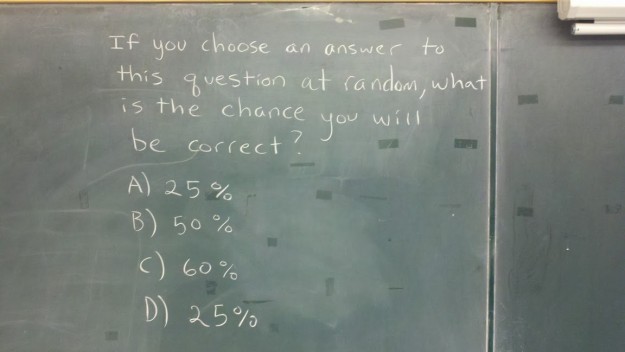
A difficulty that students often face is that exam questions like this may be interpreted a number of ways, with each interpretation leading to a distinctly different answer. In this post, I offer two such interpretations.

The first leads to the same answer as one of our readers: "0% the correct answer is not among the choices." Here we assume that the question that needs a correct answer is "what is the chance you will be correct," and that you would only be "correct" if the probability of picking your answer is the same as the value of your chosen answer.

Say, you randomly pick "25%". Since two out of the four choices represent "25%", then the probability of randomly picking it is 50% (assuming equal likelihood). And since your answer--25%--is not the same as the probability of picking your answer--50%--then you will have been incorrect.

Using the same logic, it's easy to see how picking the other two available choices, 50% and 60%, would also be incorrect. This means that the chance that you will be correct is zero--there is no chance that you will be right!

Of course, if you read the problem differently, you should arrive at a different answer. For example, if we assume that "being correct" refers to some other arbitrary question, that the choices pertain to that question and not to the chance that your answer will be correct, and that one of the given choices is the correct answer, then we'll arrive at an altogether different solution.

We are still interested in the probability of randomly picking a correct answer, but this time we do not limit this probability to the given choices. We could go through equations and basic laws of probability to solve the problem, and in the end we'll most probably arrive at the correct solution, but there is a simple way of reasoning out the correct solution instead. 

First we recognize that there are only three possible answers to the problem: 25%, 50%, and 60%. If we assume that the three are equally likely to be the correct answer, then the probability that each will be correct is 1/3. Or,
  • If C = the correct answer, where C = 25%, 50%, or 60%. Assuming these choices are equally likely to be correct, then the probability of C, P(C = 25%) = P(C = 50%) = P(C = 60%) = 1/3.

Since the probabilities are all the same, then the actual choice we pick does not matter: whatever we choose, the probability that it will be the correct answer is 1/3.

Can you think of another approach to solving the problem? Feel free to share your thoughts in the comments section below.

Thursday, November 3, 2011

Tuesday, July 27, 2010

10 Things You Need to Know About Procrastination

IN THE NEWS from Psychology Today


How many times have we seen ourselves stare at the computer monitor, going over Google Reader feeds and Digg posts, taking care of our Farmville farm or simply going over our Facebook news feed, spending hours on end to ultimately accomplish nothing. Procrastination is unproductive action or simple inaction; it is deferring something that needs to be done for other inconsequential things. It is is the single biggest reason why people fail in their careers and in life: it's why people get dumped, get demoted, don't get a raise, don't get promoted, get fired, file for separation or divorce, grow old alone, and die a miserable death. It's like a cancer that slowly gnaws at our productivity, and eventually our potential for financial success. Here are a few important things that you need to know about procrastination before it eats you alive...

1. Twenty percent of people identify themselves as chronic procrastinators. For them procrastination is a lifestyle, albeit a maladaptive one. And it cuts across all domains of their life. They don't pay bills on time. They miss opportunities for buying tickets to concerts. They don't cash gift certificates or checks. They file income tax returns late. They leave their Christmas shopping until Christmas eve.

2. It's not trivial, although most people don't take it seriously as a problem. It represents a profound problem of self-regulation.

3. Procrastination is not a problem of time management or of planning. Procrastinators are not different in their ability to estimate time, although they are more optimistic than others.

4. Procrastinators are made not born. Procrastination is learned in the family milieu, but not directly. It is one response to an authoritarian parenting style. Having a harsh, controlling father keeps children from developing the ability to regulate themselves, from internalizing their own intentions and then learning to act on them. Procrastination can even be a form of rebellion, one of the few forms available under such circumstances. What's more, under those household conditions, procrastinators turn more to friends than to parents for support, and their friends may reinforce procrastination because they tend to be tolerant of their excuses.

5. Procrastination predicts higher levels of consumption of alcohol among those people who drink. Procrastinators drink more than they intend to—a manifestation of generalized problems in self-regulation. That is over and above the effect of avoidant coping styles that underlie procrastination and lead to disengagement via substance abuse.

6. Procrastinators tell lies to themselves. Such as, "I'll feel more like doing this tomorrow." Or "I work best under pressure." But in fact they do not get the urge the next day or work best under pressure. In addition, they protect their sense of self by saying "this isn't important." Another big lie procrastinators indulge is that time pressure makes them more creative. Unfortunately they do not turn out to be more creative; they only feel that way. They squander their resources.

7. Procrastinators actively look for distractions, particularly ones that don't take a lot of commitment on their part. Checking e-mail is almost perfect for this purpose. They distract themselves as a way of regulating their emotions such as fear of failure.

8. There's more than one flavor of procrastination. People procrastinate for different reasons. Psychologists identify three basic types of procrastinators:
  • Arousal types, or thrill-seekers, who wait to the last minute for the euphoric rush.
  • Avoiders, who may be avoiding fear of failure or even fear of success, but in either case are very concerned with what others think of them; they would rather have others think they lack effort than ability.
  • Decisional procrastinators, who cannot make a decision. Not making a decision absolves procrastinators of responsibility for the outcome of events.

9. There are big costs to procrastination. Health is one. Just over the course of a single academic term, procrastinating college students had such evidence of compromised immune systems as more colds and flu, more gastrointestinal problems. And they had insomnia. In addition, procrastination has a high cost to others as well as oneself; it shifts the burden of responsibilities onto others, who become resentful. Procrastination destroys teamwork in theworkplace and private relationships.

10. Procrastinators can change their behavior—but doing so consumes a lot of psychic energy. And it doesn't necessarily mean one feels transformed internally. It can be done with highly structured cognitive behavioral therapy.
Related Posts Plugin for WordPress, Blogger...